
Dr. Cary Goldstein holds a Certificate of Prosthodontics from the University of Southern California. Prosthodontics is the dental specialty built for complex tooth replacement. Not every dentist offering dentures in Atlanta has that training. At Goldstein Dental Center, it is the foundation for every denture we make.
Full, Partial, and Implant-Supported: Which Option Is Right for You?
Dentures replace missing teeth, but not all dentures work the same way or serve the same patient. The right solution depends on how many teeth are missing, the health of your remaining teeth, your jawbone density, and your goals for function and long-term fit. Dr. Goldstein starts every consultation by mapping out the options that apply to your specific case, with no pressure toward a particular path.
Complete dentures replace all teeth in the upper or lower arch. They rest on the gum ridge and rely on suction and natural anatomy to stay in place. Upper dentures are generally more stable than lower ones, which is why Dr. Goldstein often recommends implant support for the lower arch.
Partial dentures fill gaps when healthy natural teeth remain. They attach to existing teeth with clasps or precision attachments and are removable for cleaning. A well-made partial protects remaining teeth from shifting and distributes chewing load more evenly across the arch.
Implant-supported dentures are anchored to two or more dental implants placed in the jawbone. They require no adhesive, do not cover the full palate on the upper arch, and provide a far more stable base for eating and speaking. For patients with sufficient bone density and good overall health, this is the direction Dr. Goldstein typically recommends for long-term outcomes.
Overdentures snap onto two or more implants and can be removed for cleaning. They offer meaningful improvement over traditional dentures at a lower investment than a full implant-fixed solution. Dr. Goldstein considers this the minimum standard for most lower-arch cases, where traditional denture stability is hardest to achieve.
Immediate dentures are placed the same day as extractions. They serve as a functional placeholder while gums and bone heal. A final, precisely fitted set is made once healing is complete.
During your consultation, Dr. Goldstein reviews imaging, examines the bone and tissue condition, and explains which options are realistic for you. You leave knowing what is possible, what each path involves, and what to expect on cost and timeline.
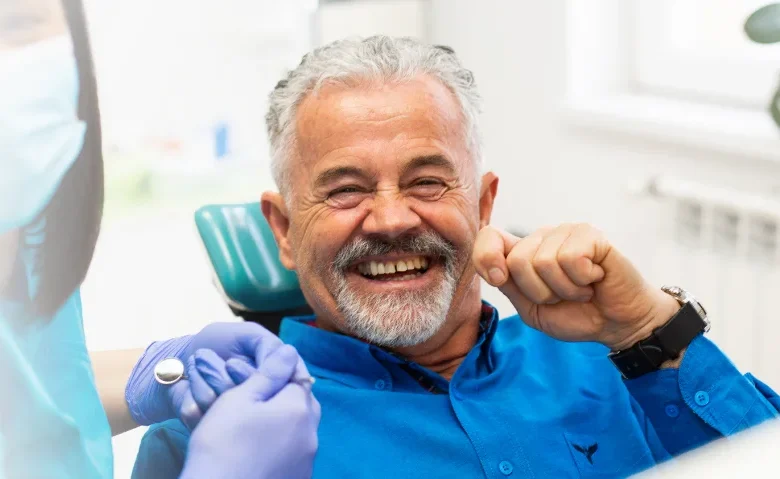
Why Implant-Supported Dentures Produce Different Outcomes
Traditional dentures sit on top of the gum and jawbone. The fit is good at first, then it changes. Without the stimulation of tooth roots, the jawbone resorbs over time. The denture that fit well two years ago may start to move during eating or speaking. Adhesive becomes a daily requirement. Certain foods are avoided. The jawline begins to look sunken.
Implant-supported dentures change this because the implants take the place of tooth roots. They integrate with the jawbone and provide the stimulation that slows bone loss. The denture snaps or clips onto the implants with a connection that does not shift during meals or conversation.
For the upper arch, implant support allows the denture to be made without a full palate plate. This restores the ability to taste temperature and texture. Patients who have worn traditional upper dentures consistently name this as one of the most significant improvements to daily quality of life.
Candidacy depends on bone volume at the implant sites, overall health, and gum tissue condition. Most patients with adequate bone density are good candidates. Patients who have experienced significant bone loss may still qualify after bone grafting, which Dr. Goldstein outlines as part of a staged treatment plan at your consultation.
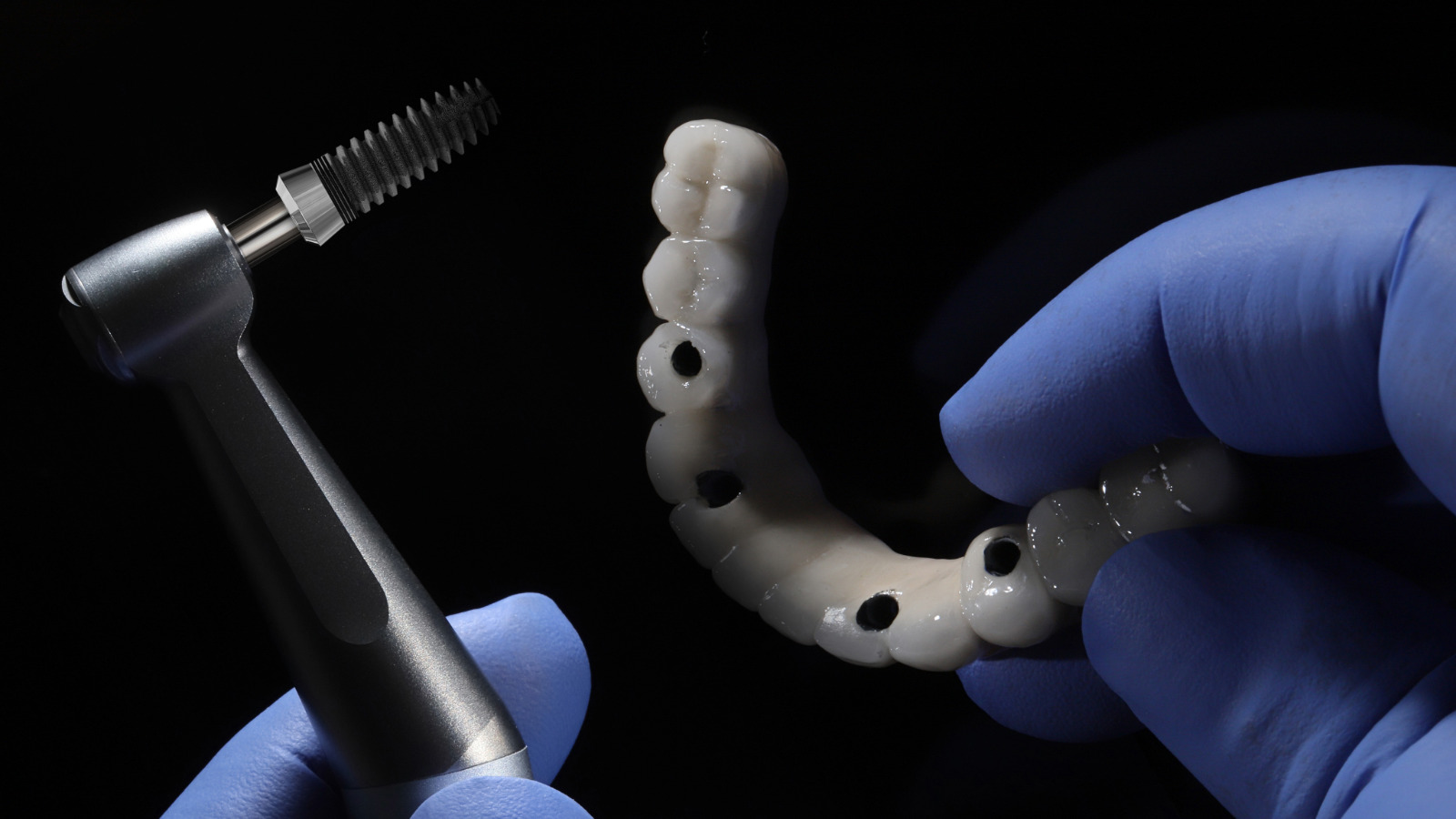
All-on-4 in Atlanta
All-on-4 is a full-arch tooth replacement using four implants per arch to support a fixed, non-removable prosthetic. Unlike removable implant-supported dentures, the All-on-4 prosthetic stays in place permanently. It functions like natural teeth and provides the highest level of stability and function available in full-arch replacement.
The four implants are positioned at angles that maximize contact with available bone. This is what makes All-on-4 work for patients who could not support individual implants at every tooth position. For many patients with significant full-arch tooth loss, it is the most effective and accessible path to a permanent, fixed solution.
At Goldstein Dental Center, All-on-4 is the starting point for full-arch planning. Dr. Goldstein’s approach is to evaluate whether the anatomy supports five or six implants, and to use that additional support when it does. The clinical reason: five or six implants distribute bite forces more evenly and add a layer of redundancy. If four implants are placed and one does not integrate, the entire prosthetic needs to be remade from scratch. With five or six, that risk is substantially reduced, and in most cases the existing prosthetic can be retained. When anatomy supports it, the additional implants are worth it.
The result is that most patients treated here end up with All-on-5 or All-on-6 restorations. All three configurations are excellent solutions. The distinction is what anatomy allows and what delivers the most stable long-term outcome for that patient.
Because the outcome depends on precise implant planning and prosthetic design, this work is not interchangeable across providers. Dr. Goldstein’s prosthodontic training and four decades of full-arch cases inform every step of the treatment plan. Surgical placement is performed by specialist surgical partners working from his pre-surgical restoration plan.

The Goldstein Denture Process
Getting dentures that fit well and look natural requires precision at every step. At Goldstein Dental Center, the process is built to take time where it matters and to move efficiently where waiting only extends discomfort.
Consultation. The first appointment is a comprehensive exam. Dr. Goldstein reviews your existing teeth, jawbone condition, bite relationships, and facial structure. He discusses your goals and lays out a clear treatment plan with realistic expectations on timeline and investment. You will not leave this appointment with unanswered questions.
Impressions and measurements. Detailed impressions capture the precise contours of your mouth. Bite registration records the relationship between your upper and lower jaws. These measurements are the foundation for a denture that occludes correctly and does not slip under load.
Wax try-in. Before final fabrication, a wax model of your new teeth is placed in your mouth. You evaluate tooth shape, position, and color before anything is locked in. Adjustments are made at this stage, not after the permanent denture is finished. GDC believes this step is very important so that you get to evaluate the final result in your mouth and make sure the look is what you want.
Extractions, if needed. If remaining teeth need to be removed, the sequence is planned carefully. For patients who cannot tolerate being without teeth during healing, immediate dentures can be placed at the time of extraction so there is no period without a functional smile.
Final fitting. Your finished dentures are placed and adjusted. Dr. Goldstein evaluates the bite in multiple positions, the fit against the gum tissue, and the aesthetics from multiple angles. You leave with care instructions and a follow-up appointment already scheduled.
Dentures settle, sort of like new shoes get worn in. We plan for this and want you to come in a few days after your dentures are delivered to allow us to re-evaluate them and make final minor adjustments, so that you are very comfortable. These follow-up visits are included and there are no extra fees incurred by you.
Ongoing care. Fit changes over time as the jawbone remodels. Routine follow-up appointments catch these changes early. A reline restores snug fit and avoids the problems that accumulate when a loosening denture goes unaddressed.
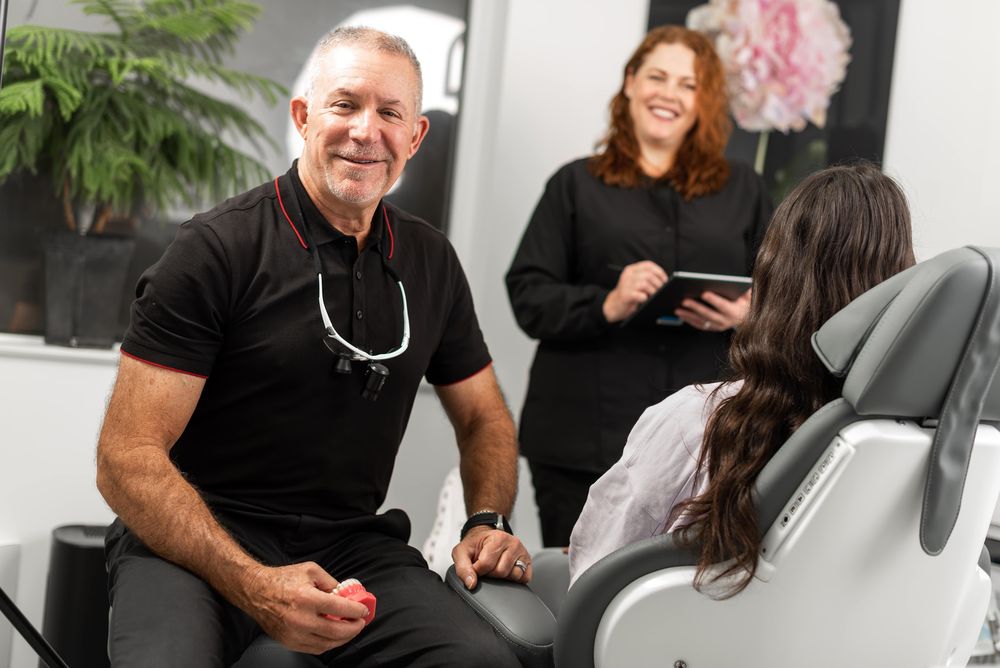
Why a Prosthodontist Makes the Difference
Prosthodontics is the dental specialty focused on restoring and replacing teeth, with particular depth in full-arch loss, implant-supported prosthetics, and bite reconstruction. Specialty training requires two to three years beyond dental school and is focused specifically on this work.
Dr. Goldstein earned his Certificate of Prosthodontics at the University of Southern California in 1986. He has been placing and restoring full-arch prosthetics for nearly four decades. He holds a clinical faculty position at the Dental College of Georgia, where he has taught oral rehabilitation since 1992. In 2020, he served as President of the American Academy of Esthetic Dentistry, an invitation-only organization of the leading practitioners and educators in restorative and esthetic dentistry worldwide.
For dentures specifically, prosthodontic training matters at three points. First, occlusion: the bite relationship across a full arch determines whether a patient can chew without strain and whether jaw joints stay comfortable over years of wear. Getting this right requires specialist-level precision. Second, implant prosthetics: how a prosthetic loads an implant system, how the retention mechanism is designed, and how implant positions are planned for the prosthetic outcome requires training that goes beyond general dentistry. Third, aesthetics: tooth shape, position, gum contour, and their relationship to facial structure are not intuitive. A denture that looks like a denture is almost always the product of shortcuts at this stage.
Most practices offering dentures in Atlanta are general or cosmetic dental offices. Prosthodontic specialty training is not common. For patients considering a full-arch replacement, it is worth understanding the distinction before choosing a provider.
Frequently Asked Questions
How much do dentures cost in Atlanta?
The investment varies depending on the type of denture, whether extractions or bone grafting are needed, materials used, and the level of prosthetic customization involved. Traditional full dentures typically cost less than partial or implant-supported options. Implant-supported solutions carry a higher upfront cost but often provide better long-term value because the fit does not degrade at the same rate. We work with CareCredit to provide flexible payment options. Ask about financing at your consultation.
What is the difference between implant-supported and traditional dentures?
Traditional dentures rest on the gum and stay in place through suction and, often, adhesive. Implant-supported dentures are anchored to implants placed in the jawbone, which means they do not shift, do not require adhesive, and help preserve bone by providing stimulation at the implant sites. They are more comfortable over time because the fit does not change as the jawbone remodels.
Am I a good candidate for implant-supported dentures?
Candidacy depends on jawbone density at the implant sites, overall health, and gum tissue condition. Most patients with adequate bone volume qualify. Patients with significant bone loss may still be candidates after bone grafting, which can be planned as part of a staged treatment approach. For patients with significant upper-arch bone loss, Zygomatic implants are another option. These longer implants engage denser bony areas beyond the jaw ridge to provide stable support for upper dentures. The most accurate way to determine candidacy is a consultation with current imaging, which Dr. Goldstein reviews directly.
What is All-on-4 and how does it differ from regular implant dentures?
All-on-4 uses four implants per arch to support a fixed, non-removable prosthetic. It differs from removable implant-supported dentures in that it does not come out at night and provides the highest level of stability and function available in full-arch replacement. The implants are angled to work with available bone, making it an option for patients who may not qualify for a full set of individual implants.
How long do dentures last?
Traditional dentures typically last five to ten years before the fit changes enough to require replacement or relining, as the jawbone remodels. Most denture teeth are made from specialized resin that also dulls and flattens over that same period. When that happens, the teeth can be replaced or a new denture fabricated. Implant-supported dentures can last significantly longer because the implants themselves are permanent fixtures in the bone. The prosthetic portion will eventually wear and may need replacement, but the implants remain. With regular check-ups, fit changes are caught and corrected before they become a problem.
Does dental insurance cover dentures?
Many dental insurance plans include partial coverage for traditional full or partial dentures. Implant-supported dentures are less consistently covered, though some plans include a benefit for the denture component. Coverage varies widely by plan and employer. Our team verifies your benefits before your first appointment and outlines your estimated out-of-pocket cost at the consultation.
Our patients us in
Metro Atlanta
Ready to Understand Your Options?
Replacing missing teeth is one of the higher-stakes decisions in dentistry. The provider you choose, the approach they recommend, and the precision of the prosthetic all have long-term consequences. A consultation with Dr. Goldstein is the starting point for understanding what is realistic for your specific case and what each path involves.
Serving patients in Buckhead, Sandy Springs, Dunwoody, and surrounding Atlanta communities.
Goldstein Dental Center | 4320 Roswell Road NE, Atlanta, GA 30342 | (404) 869-7711