


Visit the Patient Center to learn what to expect from your first visit, forms, financial policies, and frequently asked questions!
The Dental Implant Process, Step by Step: What to Expect and How Long It Takes
Getting a dental implant takes longer than most patients expect, typically 3 to 6 months from consultation to final crown, sometimes longer if bone grafting is needed. Understanding exactly what happens at each stage makes the timeline feel manageable rather than intimidating. This post walks through the full process, including the parts most practices don’t explain clearly upfront.
Schedule an Implant Consultation
Phase 1: Evaluation and Treatment Planning
A proper implant evaluation is not a single photograph and a conversation. It requires current clinical imaging, typically a cone beam CT scan, to assess the bone volume and density at the implant site, the proximity of nerves and sinuses, and the condition of adjacent teeth. Without that imaging, a practice cannot tell you whether you are a good implant candidate, how many implants are needed, or whether preparatory work will be required.
At Goldstein Dental Center, the planning phase also includes an evaluation of how the final crown will integrate with your bite and surrounding teeth. Planning for adequate bone and tissue to prevent spaces where food will collect must happen in advance, not as an afterthought. This is the prosthodontic difference: the restorative outcome is designed before the surgical phase begins, not after. The final crown dimensions and position inform where and how the implant is placed, which affects both the outcome and the healing process.
That planning happens in 3D. Dr. Goldstein and the surgical team plan each implant placement on 3D software, effectively performing the procedure on a computer before touching the patient. This allows the team to evaluate the outcome in advance, select the optimal implant brand and dimensions for the specific site, and determine whether any preparatory bone or soft tissue work is needed to close gaps and prevent food traps. There are more than 40 implant brands available, each with different sizes and performance profiles, and the right selection depends on the anatomy of each individual site.
From this planning data, a surgical guide is fabricated. It ensures the implant is placed at the precise angle and position in the jawbone for ideal healing and restoration fit. Patients do not need to be present for this planning phase. It is completed entirely from the CT scan data, and the result is a surgical procedure executed to a predetermined plan, not decided in the moment.
For patients considering implants as part of a larger restorative or cosmetic treatment plan, this planning phase determines the full sequence of the case. The implant is one component of that plan, not an isolated procedure. At Goldstein Dental Center, those roles are split deliberately: Dr. Goldstein manages the restorative and planning phase, and the surgical team handles placement, both working from the same plan.
Phase 2: Preparatory Work (If Needed)
Not every patient requires preparatory work before implant placement. Patients who do fall into a few categories:
Tooth extraction, if the tooth being replaced is still present. In most cases, there is a healing period of 6 to 12 weeks between extraction and implant placement to allow the socket to heal. In selected cases, immediate placement at the time of extraction is possible, but it requires specific bone conditions.
Bone grafting is required when there is insufficient bone volume to support an implant post. This is common in patients who have had a tooth missing for more than a year, as the jawbone begins to resorb at the site of a missing root over time. Bone grafting adds 3 to 4 months to the total timeline.
Sinus lift procedures may be required for upper jaw implants in the posterior area, where the sinus floor can be positioned very close to the alveolar ridge. A sinus lift creates additional bone volume in that area.
None of these steps are unexpected complications. They are predictable clinical needs that an experienced evaluation identifies upfront and plans for, rather than discovering mid-treatment.
Phase 3: Implant Placement Surgery
Implant placement is a surgical procedure performed under local anesthesia. Sedation is available for patients who prefer it. The procedure typically takes 1 to 2 hours for a single implant.
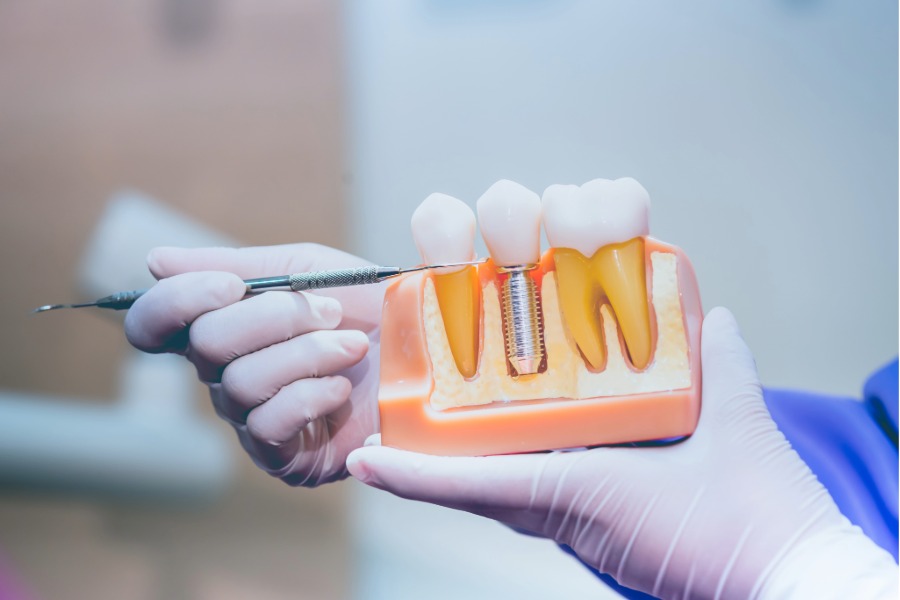
During placement, a small incision is made in the gum tissue, a channel is drilled into the jawbone at the planned position and angle, and the titanium implant post is placed. The surgical guide ensures the placement matches the plan precisely. The gum is sutured closed, and the implant is left to integrate with the bone. A healing cap or temporary crown may be placed, depending on the case.
At Goldstein Dental Center, surgical placement is performed by top specialists, including Dr. Bruce Edelstein, a periodontist whose work Dr. Goldstein has collaborated with across many cases. The restorative and surgical phases are coordinated from the beginning, not treated as separate referrals.
Post-procedure: most patients experience discomfort, swelling, and some bruising for a few days. Pain is typically manageable with over-the-counter medication. Most patients return to normal activity within a day or two, with some dietary restrictions for the first week.
Phase 4: Healing and Osseointegration
Osseointegration is the process by which the jawbone grows around and bonds to the titanium implant surface, creating the stable root that makes the implant function like a natural tooth. This process takes 3 to 6 months in most patients, and it cannot be shortened. An implant loaded with a permanent crown before osseointegration is complete will fail.
During this period, the patient is typically wearing a temporary crown or bridge over the implant site. Function is maintained, and the site looks normal. Follow-up imaging confirms that integration is proceeding correctly.
Signs that healing is going well: minimal discomfort after the first week, no unusual swelling or persistent pain, no mobility in the implant when tested at follow-up. Signs that warrant a call: persistent pain after 2 weeks, visible implant movement, or unusual discharge at the site.
Phase 5: Abutment and Final Crown Placement
Once osseointegration is confirmed, the final restorative phase begins. An abutment, the connector between the implant post and the crown, is attached. Impressions or digital scans are taken for crown fabrication, and the case goes to the laboratory.
The design of the final crown is where prosthodontic training shows most clearly. The crown must integrate with the adjacent teeth in color, shape, and occlusal contact. It must distribute biting force correctly. And it must look like it belongs in the mouth, not like a prosthetic component. At Goldstein Dental Center, crown design goes through the same ceramist relationship used for veneer cases. The quality standard is the same.
The final placement appointment involves checking fit, shade, occlusion, and bite before the crown is permanently cemented. Minor adjustments at this stage are normal. After final placement, the implant-supported crown functions identically to a natural tooth.
Do Dental Implants Hurt? The Honest Answer
During placement: no. The procedure is performed under local anesthesia. Patients typically feel pressure but not pain during the procedure itself. Sedation is available for patients with significant anxiety.
After placement: yes, some discomfort, but typically manageable. Most patients describe post-procedure soreness comparable to a tooth extraction, not surgical pain. Ibuprofen and acetaminophen are usually sufficient. Swelling peaks at day 2 to 3 and resolves over the following week. Ice packs in the first 24 hours help.
The osseointegration period is not painful for most patients. It is a healing process that happens without sensation. If you are experiencing significant pain weeks after placement, contact your provider. It is not expected.
How Dr. Goldstein Approaches Implant Restoration
Dr. Goldstein’s role in implant cases is the restorative and planning specialist. He coordinates the evaluation, designs the final crown and restoration before surgical placement begins, works with the surgical team on the surgical phase, and executes the final restoration. Patients benefit from a continuous planning relationship rather than two providers who do not communicate with each other.
The quality of the surgical work directly affects the quality of the restoration. That is why the choice of surgical partner matters as much as the choice of restorative dentist.
Schedule Your Implant Evaluation
Serving patients in Buckhead, Atlanta, Sandy Springs, Roswell, Alpharetta, and surrounding communities.
Frequently Asked Questions
How long does the dental implant process take?
From initial consultation to final crown, the typical timeline is 3 to 6 months for straightforward cases. Cases requiring bone grafting add 3 to 4 months. Cases requiring tooth extraction add 6 to 12 weeks before placement, if there was bone loss or severe infection. The osseointegration period after placement cannot be shortened. It is the phase that determines implant stability.
Do dental implants hurt during placement?
The placement procedure is performed under local anesthesia. Most patients report feeling pressure rather than pain during the procedure. Sedation options are available for anxious patients. Post-procedure soreness is common for several days, typically manageable with over-the-counter pain medication.
How long does it take for a dental implant to heal?
Osseointegration, the process of the bone bonding to the titanium post, takes 2 to 6 months in most patients. This is the biological minimum and cannot be accelerated. Placing a permanent crown before this process is complete compromises implant stability.
What can I eat after dental implant surgery?
Soft foods for the first week: eggs, yogurt, soft fish, cooked vegetables, smoothies. Avoid hard, crunchy, or chewy foods at the implant site during the healing period. Most patients return to a normal diet within a few weeks, with some caution around the implant site until osseointegration is confirmed.
How long do dental implants last?
Dental implants placed and restored correctly can last 25 years or more, with many lasting a lifetime. The crown on top of the implant typically needs replacement at 15 to 20 years, but the implant post itself, if well maintained, is often permanent.
Am I a good candidate for dental implants?
Good candidates have adequate bone density and volume at the implant site, no uncontrolled periodontal disease, good overall health and healing capacity, and commitment to the maintenance protocol. Patients with insufficient bone may be candidates after bone grafting. An evaluation with imaging is necessary to determine candidacy for your specific situation.
Learn more on our blog!
Stay up to date on your dental health and hygiene with our blog!