


Visit the Patient Center to learn what to expect from your first visit, forms, financial policies, and frequently asked questions!
Dental Implants vs. Bridges: How a Prosthodontist Helps You Choose
When a tooth is lost or needs to come out, most patients face a version of the same question: implant or bridge? The answer depends on bone density, adjacent tooth health, timeline, and budget, but also on who is guiding the decision. A prosthodontist evaluates these factors differently than a general dentist, and for complex cases, that difference changes the outcome.
What Each Option Actually Does
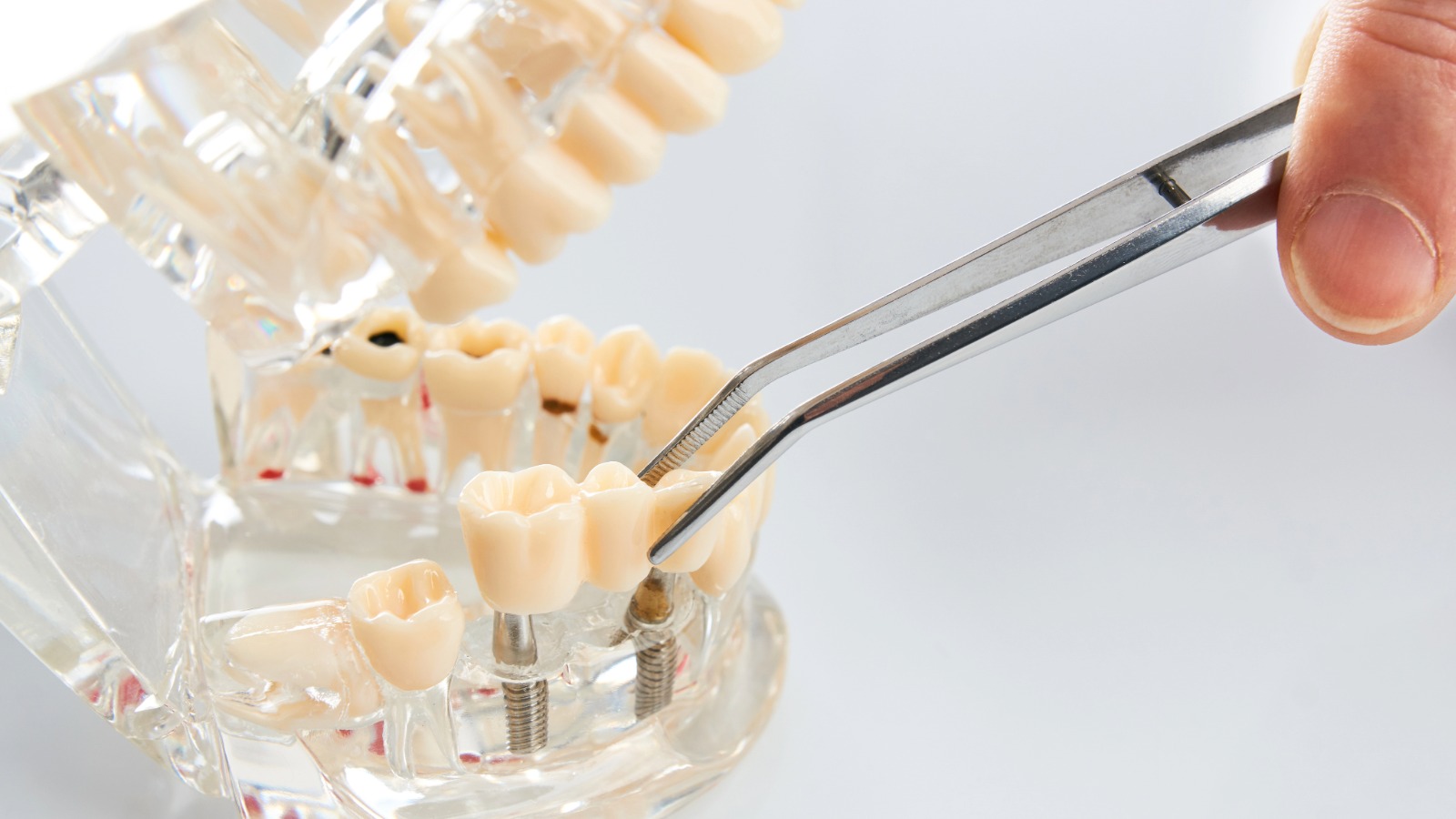
A dental implant replaces both the root and the crown of a missing tooth. A titanium post is placed into the jawbone by a surgical specialist, a temporary tooth is made to close the space, then left to integrate with the bone over a period of three to six months. Once that integration is complete, a custom-fabricated crown is placed on top of the implant. The result functions and feels like a natural tooth, and because the titanium root preserves the jawbone, it prevents the bone loss that occurs when a tooth is missing for an extended period.
A dental bridge spans the gap created by a missing tooth by placing crowns on the two adjacent teeth and suspending a false tooth between them. The adjacent teeth are prepared (reduced in size) to accept the crowns, and the bridge is fabricated as a single unit and cemented in place. No surgery is involved, and the process is typically complete within a few weeks.
The fundamental difference: an implant replaces the root; a bridge does not. That distinction drives most of the clinical and long-term financial differences between the two options.
Goldstein Dental Center performs the restorative and planning phase of implant treatment. Surgical placement is handled by Dr. Bruce Edelstein and Dr. Christopher Pesut.
The Case for Dental Implants
For most patients with a single missing tooth and adequate bone density, a dental implant is the superior long-term solution. The reasons:
Longevity. Implants have a documented lifespan of 25 or more years when placed and restored correctly, with many lasting significantly longer. Dental bridges typically need replacement at the 10 to 15 year mark.
Adjacent tooth preservation. A bridge requires preparing, and permanently altering, the two teeth on either side of the gap. If those teeth are healthy, grinding them down to accept crowns is a clinical compromise. An implant leaves adjacent teeth untouched.
Bone preservation. The jawbone requires the stimulation of tooth roots to maintain its density. When a tooth is lost and not replaced with an implant, the bone in that area gradually resorbs. This can affect the fit of a bridge over time and changes the facial profile around the jaw in cases with multiple missing teeth.
Long-term cost. The higher upfront cost of an implant is frequently lower over a 20-year period when compared to the cost of replacing a bridge at the 10 to 15 year mark, the crown replacements that often accompany that, and the management of bone loss.
The Case for a Dental Bridge
Bridges are not a lesser choice. For the right clinical situation, they are the appropriate one.
When the adjacent teeth on either side of the gap already need crowns, a bridge addresses three teeth in a single treatment rather than requiring a separate implant procedure. That changes the cost equation substantially.
When bone loss is already present, whether from periodontal disease or from a tooth that has been missing for some time, implant placement may require bone grafting before placement is possible. In some cases the bone loss is too significant for grafting to be practical. A bridge can still be placed in these situations.
Timeline matters for some patients. An implant requires a surgical procedure followed by three to six months of osseointegration before the final crown can be placed. A bridge is typically complete in two to four weeks. For patients who cannot manage a long treatment timeline, or for whom surgery is not advisable, a bridge is the practical option.
The Decision Factors: What Actually Matters
When Dr. Goldstein evaluates a tooth replacement case, the clinical factors he considers include:
- Bone density and volume at the site of the missing tooth
- The condition of the adjacent teeth, and whether they already need restorative work
- How long the tooth has been missing, and how much bone loss has already occurred
- The location of the missing tooth in the mouth (front teeth vs. posterior teeth have different load requirements)
- The patient’s overall health and healing capacity
- Budget and timeline realities
- None of these factors can be properly assessed without clinical imaging and examination. A practice that recommends an implant or a bridge without reviewing a current cone beam or periapical series is advising without the information needed to advise correctly.
When the Answer Is Neither, or Both
For patients with multiple adjacent missing teeth, neither a single implant nor a traditional bridge may be the most appropriate solution. An implant-supported bridge uses two implants as anchors with one or more suspended teeth between them, combining the bone preservation benefits of implants with the efficiency of a bridge for replacing multiple teeth. This is a fixed option – it stays in place and is not removed for cleaning, compared to a removable appliance, which replaces the teeth but must be taken out daily.
For patients who have lost most or all of their teeth, full-arch solutions, whether implant-supported dentures, All-on-4 arches, or individual implants within a comprehensive reconstruction plan, are different clinical conversations. A prosthodontist plans these cases at a level of complexity that requires the same training used in full mouth reconstruction.
How Dr. Goldstein Approaches This Decision
Dr. Goldstein is a prosthodontist. His specialty is specifically the restoration and replacement of teeth, including the planning of complex cases that involve multiple treatment options across multiple providers.
For cases involving implants, Goldstein Dental Center handles the restorative and planning phase. Surgical placement is performed by a carefully selected group of surgical specialists, primarily Dr. Bruce Edelstein, a periodontist who handles the majority of Dr Goldstein’s surgical referrals. The restorative and surgical teams work in close coordination so that the final crown and the surgical placement are planned together from the beginning.
For bridge cases, the crown fabrication and bite integration are handled entirely within the practice. Patients receive the same level of design and material quality as a veneer or implant-supported crown case.
The consultation at Goldstein Dental Center will give you a clinical assessment of your specific situation, imaging review, and a clear recommendation with the reasoning behind it.
Schedule Your Implant or Bridge Consultation
Serving patients in Buckhead, Atlanta, Sandy Springs, Roswell, Alpharetta, and surrounding communities.
Frequently Asked Questions
Are dental implants better than bridges?
For most patients with adequate bone density and healthy adjacent teeth, implants are the superior long-term choice. They preserve bone, leave adjacent teeth untouched, and last 25 or more years. Bridges are appropriate when adjacent teeth already need crowns, when bone loss makes implant placement impractical, or when a shorter timeline is needed.
How long do dental bridges last compared to implants?
Dental bridges typically need replacement at 10 to 15 years. Dental implants, when placed and restored correctly, can last 25 years or more. Over a 20-year period, the total cost of bridge replacement often exceeds the upfront cost difference of an implant.
Do dental implants hurt?
Implant placement surgery is performed under local anesthesia or sedation. Most patients report that post-procedure discomfort is manageable with over-the-counter pain medication and resolves within a few days to a week. The osseointegration period that follows is typically not painful. Discomfort varies by case complexity and individual healing.
How much do dental implants cost vs. bridges in Atlanta?
A single dental implant (post, abutment, and crown) at specialist practices in Atlanta typically ranges from $3,500 to $6,000 or more depending on complexity. A dental bridge typically ranges from $2,500 to $5,000 for a three-unit span. Confirm exact Goldstein pricing at your consultation.
Can I get a dental bridge instead of an implant?
Yes. A bridge is an appropriate choice in specific clinical situations. The decision depends on the condition of the adjacent teeth, available bone, timeline, and budget. A prosthodontist can evaluate your specific situation and give you a recommendation based on the full clinical picture.
Does insurance cover implants or bridges?
Most dental insurance plans provide partial coverage for bridges, as they are classified as a restorative procedure. Dental implants are covered by some plans but excluded by others. Coverage varies significantly. It is worth reviewing your specific plan before a consultation. Goldstein Dental Center can assist with pre-authorization and insurance review.
Learn more on our blog!
Stay up to date on your dental health and hygiene with our blog!