


Visit the Patient Center to learn what to expect from your first visit, forms, financial policies, and frequently asked questions!
Full Mouth Reconstruction: Why the Specialist You Choose Changes Everything
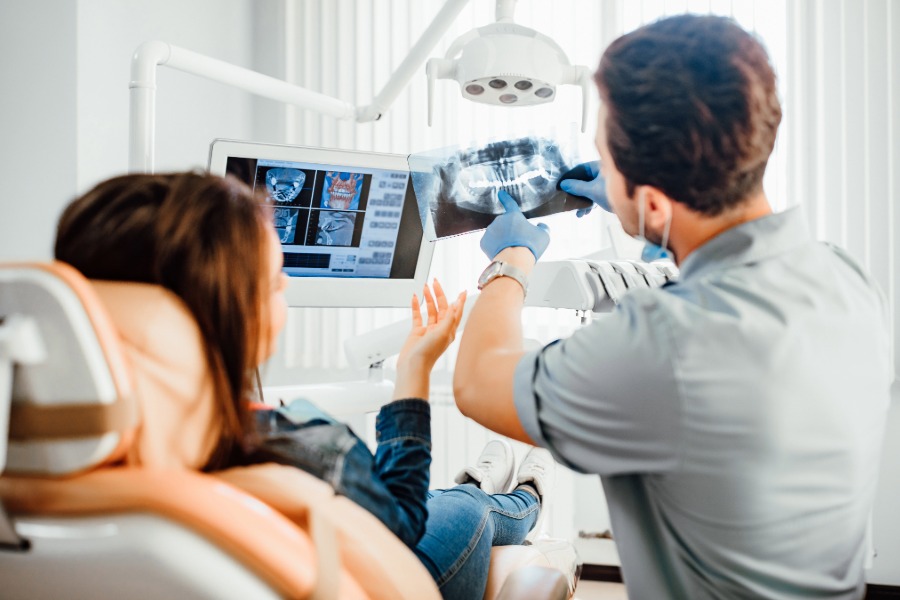
Full mouth reconstruction is one of the most complex treatment plans in dentistry: multiple procedures, sequenced over months, with each step affecting the next. Choosing who plans and executes that treatment is not a minor decision. This post explains who is trained for this work, what the credential difference actually means in practice, and the questions to ask before committing to a provider.
Schedule a Full Mouth Reconstruction Consultation
What Makes Full Mouth Reconstruction Complex
Full mouth reconstruction is not a single procedure with a predictable outcome. It is a treatment architecture, a plan that coordinates crowns, implants, bridges, bite correction, and sometimes periodontal preparation or orthodontic work, across most or all of the teeth.
The complexity is not in any individual procedure. Most of the component procedures, a crown, a bridge, an implant restoration, are performed by general dentists every day. The complexity is in the sequencing, the integration, and the planning. The order in which procedures are completed matters. The design of each restoration must account for the adjacent and opposing teeth. The bite must be assessed and managed as a system, not as a collection of individual teeth.
At Goldstein Dental Center, every full mouth reconstruction case begins with a phased treatment letter, a step-by-step game plan sent to each specialist and to the patient before treatment begins. Every member of the team, including you, follows the same sequenced plan, knows what appointments are coming, and understands what is being done and in what order. No step is completed out of sequence.
When sequencing errors occur, they compound. A crown placed before a bite correction is complete may need to be replaced when the bite changes. An implant restored without accounting for the final occlusion may fail to integrate properly with the rest of the case. These are not hypothetical risks. They are the common causes of the revision work that patients bring to specialist practices after unsatisfactory general dentistry outcomes.
The Specialist of Record: What Prosthodontics Actually Is
Prosthodontics is one of 12 dental specialties recognized by the American Dental Association. It is the specialty focused specifically on the restoration and replacement of teeth.
Completing prosthodontic specialty training requires three additional years of advanced residency after dental school, following an application and selection process comparable to medical specialty residency. The training covers smile design, occlusion, implant restoration, full-mouth planning, and the management of complex cases where function, aesthetics, and structural integrity must all be addressed simultaneously.
Dr. Goldstein completed his prosthodontic residency at the University of Southern California, one of the leading programs in the country. He also holds an adjunct professorship at the Dental College of Georgia, where he received his dental degree, and where the school has recognized his clinical standing by inviting him to teach the next generation of dentists.
For full mouth reconstruction, prosthodontics is the specialty of record. It is the training specifically designed for the complexity these cases require.
General Dentist vs. Prosthodontist for Full Mouth Cases
A general dentist can legally perform all the component procedures in a full mouth reconstruction plan. The procedures themselves are within scope. The difference is in what surrounds them: the planning architecture, the complexity management, and the capacity to anticipate and manage risk across a multi-procedure, multi-month case.
For straightforward cases with limited scope, a skilled general dentist handles them well. For cases involving significant bone loss, multiple missing teeth, complex bite correction, or an extensive number of restorations, the additional training of a prosthodontist changes the quality and durability of the outcome in ways that are difficult to quantify in advance but clear in retrospect.
The most common statement from patients who have come to a specialist for revision work: “I did not know to ask whether my dentist was trained for this type of case.” It is a distinction that patients do not know to make until they understand that the specialties exist. Think of it the way you would think about a physician who discovers a heart problem: the appropriate next step is a referral to a cardiologist, not treatment by the general practitioner. The analogy is not perfect, but the principle is the same. Complex cases benefit from specialists trained specifically for that complexity.
The Role of the Lab Relationship
Full mouth cases require precision laboratory work. The crowns, bridges, and restorations that compose a full mouth reconstruction must fit with micron-level accuracy, match in shade and morphology across multiple teeth, and integrate with the bite as a functional system.
Prosthodontists typically have established, long-term relationships with specific ceramists and laboratories whose work meets the standards of specialist practice. The ceramist knows how the prosthodontist designs and prepares cases. The restorations come back to a clinical expectation, not a surprise.
Volume production laboratories, which most general dental practices use, serve many dentists across many case types. The quality is adequate for routine work. For full mouth reconstruction, where every restoration must work together as a system, the standard required is different.
Goldstein Dental Center works with a team of master ceramists, including Chris, Ines, Isaac, and Massouda, all Atlanta-based. The relationship is built around the standard of a specialist practice: each restoration is fabricated to the specific design the prosthodontist has planned, not produced from a generic template.
Questions to Ask Any Provider Before Agreeing to Full Mouth Treatment
These questions reveal how a provider thinks about the case, not just what they can do:
- How many full mouth reconstruction cases have you completed? (Case volume tells you whether this is routine work or a stretch case for their practice.)
- What is your specialty training? (A prosthodontist answers immediately and specifically.)
- Who fabricates your restorations, and can I see examples of their work on full-mouth cases?
- How do you approach the bite and occlusion in a case of this scope?
- What happens if the bite is off after the final restorations are placed?
The quality of the answers is as revealing as the answers themselves. A specialist who has done this many times answers these questions without hesitation and with specificity. A dentist who has stretched beyond their typical case complexity will often give general answers that do not engage with the clinical detail.
Why Dr. Goldstein Is the Full Mouth Reconstruction Specialist in Buckhead
Dr. Cary Goldstein is a prosthodontist, trained at the University of Southern California and holding a professorship at the Dental College of Georgia. He served as President of the American Academy of Esthetic Dentistry in 2020, the highest elected position in the organization. Dr. Goldstein starts one to two full mouth reconstruction cases each month, making this a core part of the practice, not a stretch case.
His clinical approach to bite and occlusion draws on the full range of established occlusal frameworks: Spear, Kois, Pankey-Mann, and others studied in depth during his USC residency. The approach is not one-size-fits-all. Every patient presents a different bite, different wear patterns, and different functional demands. The reconstruction plan is designed around the specific patient, not applied from a single template. This is exactly what three years of prosthodontic residency trains for.
His clinical philosophy for full mouth cases: the final result is designed before any preparation begins. The master ceramist team, including Chris, Ines, Isaac, and Massouda, has a long-standing relationship with Goldstein Dental Center built around the standard of a specialist practice. Cases involving implants are coordinated with Dr. Bruce Edelstein, who handles the majority of surgical referrals.
Patients in Atlanta who have been told they need full mouth reconstruction, or who have already had one consultation and are uncertain about the recommendation, are welcome to a second opinion. The consultation with Dr. Goldstein will give you a clear answer about whether the plan you have been given is clinically complete and correctly sequenced.
Schedule a Full Mouth Reconstruction Consultation
Serving patients in Buckhead, Atlanta, Sandy Springs, Roswell, Alpharetta, and surrounding communities.
Frequently Asked Questions
Who specializes in full mouth reconstruction?
Prosthodontists are the dental specialists trained specifically for full mouth reconstruction. Prosthodontics is an ADA-recognized specialty requiring 3 additional years of residency after dental school, with specific training in the planning and execution of complex multi-tooth restorative cases.
Should I see a prosthodontist for full mouth reconstruction?
For cases involving significant scope – multiple missing or failing teeth, bite correction needs, complex implant planning, or extensive multi-quadrant restoration – yes. A prosthodontist’s training is specifically designed for these cases. For simpler cases involving a few teeth, a skilled general dentist may be appropriate.
What is the difference between a general dentist and a prosthodontist?
A general dentist completes 4 years of dental school and is trained to perform a wide range of procedures. A prosthodontist completes 4 years of dental school plus 3 additional years of advanced residency focused specifically on tooth restoration, smile design, implant restoration, and complex case planning. The additional training is the difference between a skilled generalist and a specialist in exactly this type of work.
How do I find a full mouth reconstruction specialist in Atlanta?
Look for a prosthodontist specifically, not just a dentist who offers full mouth reconstruction as a service. Verify their specialty training, and look for AAED membership, which indicates demonstrated case quality reviewed by peers in the field. A consultation with Dr. Goldstein at Goldstein Dental Center in Buckhead is a direct reference point.
How long does full mouth reconstruction take?
Most full mouth reconstruction cases take 3 to 12 months from initial consultation to final placement. Cases involving bone grafting, significant implant work, or orthodontic preparation can extend that timeline. Phased treatment scheduling allows the process to be spread over time without compromising the final outcome.
What credentials should a full mouth reconstruction dentist have?
Prosthodontic specialty training is the primary credential. AAED membership indicates that clinical work has been peer-reviewed by leaders in the esthetic and restorative dentistry field. Case volume in full mouth reconstruction is also meaningful, ask directly how many cases the provider has completed.
Learn more on our blog!
Stay up to date on your dental health and hygiene with our blog!